AAC(Autoclaved Aerated Concrete) was developed in 1924 by a Swedish architect, Mr. John Axel Ericson, seek for alternate building material with properties like wood.Wood has qualities like thermal insulation, firm structure, and allow smooth working with it. But wood has certain disadvantages like combustibility, decay, and termite damage.So AAC has all these properties of wood, and also it is fire and termite resistant. On the basis of study of various reference papers following conclusions were made.
Manufacturing Process
AAC is a precast product manufactured by combining pulverized fly ash, gypsum, lime,Cement water, and Aluminium powder poured into a mould.
Once added to the concrete aluminium powder reacts with lime and fly ash resulting in the formation of millions of microscopic hydrogen bubbles.
The hydrogen Bubbles cause the concrete to expand to roughly double The Times of its original volume the hydrogen subsequently evaporates leaving a high closed shale aerated concrete.Then aerated concrete is cut into blocks which are then steam and pressure cured in an autoclave for 8 to 12 hours.
Pros of ACC Blocks
Lightweight
- AAC Blocks are three to four times lighter than traditional brick; therefore, more suitable and cheaper to transport.
- AAC Block weighs approximately 50% less than standard concrete masonry block, and usage reduces the overall dead load of the building thereby allowing construction of the taller building
- Easy Workability and design flexibility
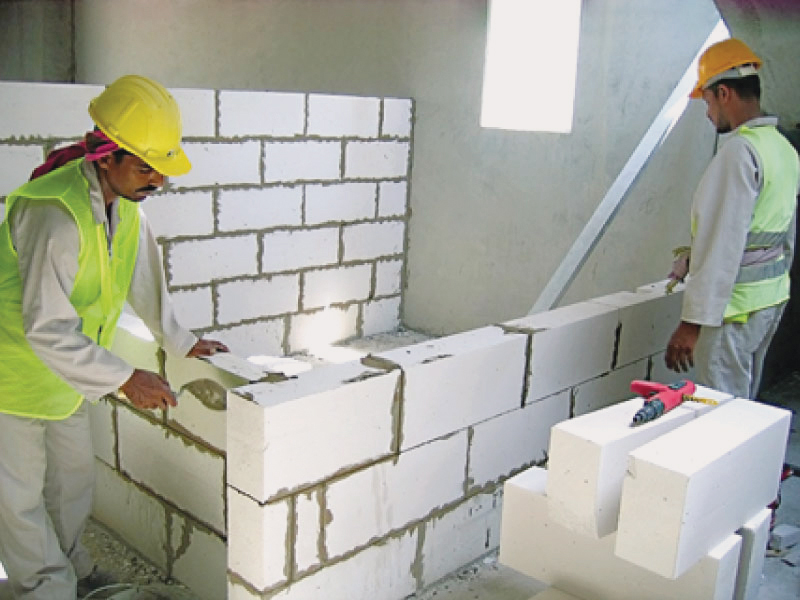
- Blocks can be easily cut drilled nailed Mild and grooved to fit individual requirements available in custom sizes simplifies hydro sanitary and electrical installations such as pipes or ducts, which we can install after the completion of the leading construction.
Faster Construction
Reduces construction time by 20% different sizes of blocks helps reduce the number of joints in wall masonry, lighter blocks facilitate more comfortable and faster construction. These blocks are easy to install also sets and hardens quickly.
Minimum Wastage
- AAC blocks have negligible breakage less than 5%; hence utilization of blocks increases.
- Thermal insulation and energy-efficient
- These blocks allow excellent thermal insulation due to tiny air pores and thermal mass of blocks. Hence helps in reducing heating and air conditioning costs of a building.
- Eco friendly and sustainable
- Mix productive use of recycled Industrial waste is a fly ash non-polluting manufacturing process. The only by-product is steam made of non-toxic ingredients that do not exist gasses.
Acoustic performance
Superior sound absorption qualities due to the porous structure of block offer sound attenuation of about 42 decibels blocking out all significant sounds and disturbances ideal for Schools, Hospitals, Hotels, Offices, Multifamily housing, and other structures that require acoustic insulation.
Fire-resistant
AAC blocks are non-combustible and fire-resistant up to 1600 degrees Celsius. These blocks are fire-resistant approximately 2 to 6 hours, depends on the thickness of the Wall.
Cost-saving
The requirement for plaster on AAC blocks is less due to the surface accuracy of the blocks, thus reduces overall construction cost by 2.5 %.
Since it requires less jointing hence minimizes the demand for cement and steel. AAC block has high insulation properties, which help in saving energy costs by almost 30%.
Variation in sizes of blocks, help in increase carpet area. Almost Nill efflorescence affects the AAC Blocks permit wall painting and plastering to serve last longer, and this translates into low maintenance cost.
Seismic resistant
The manufacturing process gives the blocks excellent strength maintaining its lightweight property due to which the steadiness of these blocks in buildings is more reliable, making it earthquake resistant.
Accuracy
ACC blocks offer high precision in size. Blocks are available in exact dimensions to provide a smooth wall with a perfect joint between different elements. It also helps to save cement and steel usage.
Termite pest-resistant
The blocks are made with inorganic materials; hence it keeps termites away, avoiding damages and losses.
Water saver
AAC Block walls do not require water for curing. Only the mortar joints need water for curing, thus reduces water consumption.
Cons of AAC Blocks
- AAC blocks are non-load-bearing material; hence it can be used only for partition walls.
- AAC blocks are well known for cracks after installation, which can be overcome by reducing the mortar strength.
- AAC blocks have brittle nature; therefore, they require more care than clay brick while handling and transporting.
- The cost per unit of AAC block is high, but overall, masonry cost is low because it requires less mortar for installation.
- Its brittle nature requires long thin screws for wall hangings and cabinets and requires a drill bit or hammering in. We have to use a large diameter wall plug, which has a higher cost than a standard plug.
- Northern European countries’ new building codes require a very thick wall if using ACC block only. Hence several builders are using traditional building methods for the installation of an extra insulation layer.
- We can’t hammer ACC block for the service like chiseling because it may break. Although we can cut ACC blocks by the carpenter’s saw easily, it is time-consuming and requires particular labour for this specific work.
ACC blocks have lower embodied energy per square meter which is not available in other concrete alternatives. As a result, impact of greenhouse gas emission is considerably less on the AAC Blocks. At the same time, AAC has much higher insulation value, which results in the reduced heating and cooling energy consumption. AAC has some significant environmental advantages over conventional construction materials, which ensures their longevity and insulation capacity. What’s more important is that total energy consumption for producing ACC is much lesser than what it takes to produce other building material. And, it, reduces 30% of environmental waste when it is used. Considering its environmental impacts, autoclaved aerated concrete is a better choice for the building as well as environment.








 Sandesh Ghimire